

I’m convinced Facebook’s “aha moment” is the most misunderstood concept in growth:
7 friends in 10 days
This one phrase is so punchy, memorable, resonant. It promises explosive growth in 5 simple words. No wonder everyone chases it.
Teams obsess over defining their own “aha moment”.
They spend quarters trying to drive it.
In doing so, they fall into 4 traps.
Here they are and how to avoid them.
Brought to you by Adora.
See why product-obsessed teams like Notion, Canva, Replit, and Granola use Adora to map their entire product, document every screen in a live design library, and surface then fix user friction. Get started here.
It’s not an epiphany
The very phrase “aha moment” implies a single, dramatic epiphany.
It suggests if you improve it, everything downstream will improve.
But real experiences don’t work this way.
It’s impossible to improve the business by just focusing on the “aha moment”.
To consider how it actually works, I like to visualize the Panama Canal.
A waterway, with a series of locks.
Working on the “aha moment” is the equivalent of lifting a gate early in the canal.
Water sloshes forward.
Then it abruptly hits the next gate.
To keep it moving, you must release the next gate… and the next… and so on.
So, yes — you might help more users reach the “aha moment”.
But by definition, they’re all “marginal” users who flipped from “not reaching it” to “now reaching it”.
They are all lower-intent than users who already found value in your product.
As a result, they abruptly hit the next gate and drop off — unless you focus on what happens next.
Celebrate the journey
You have to consider what happens next… and after that… and so on.
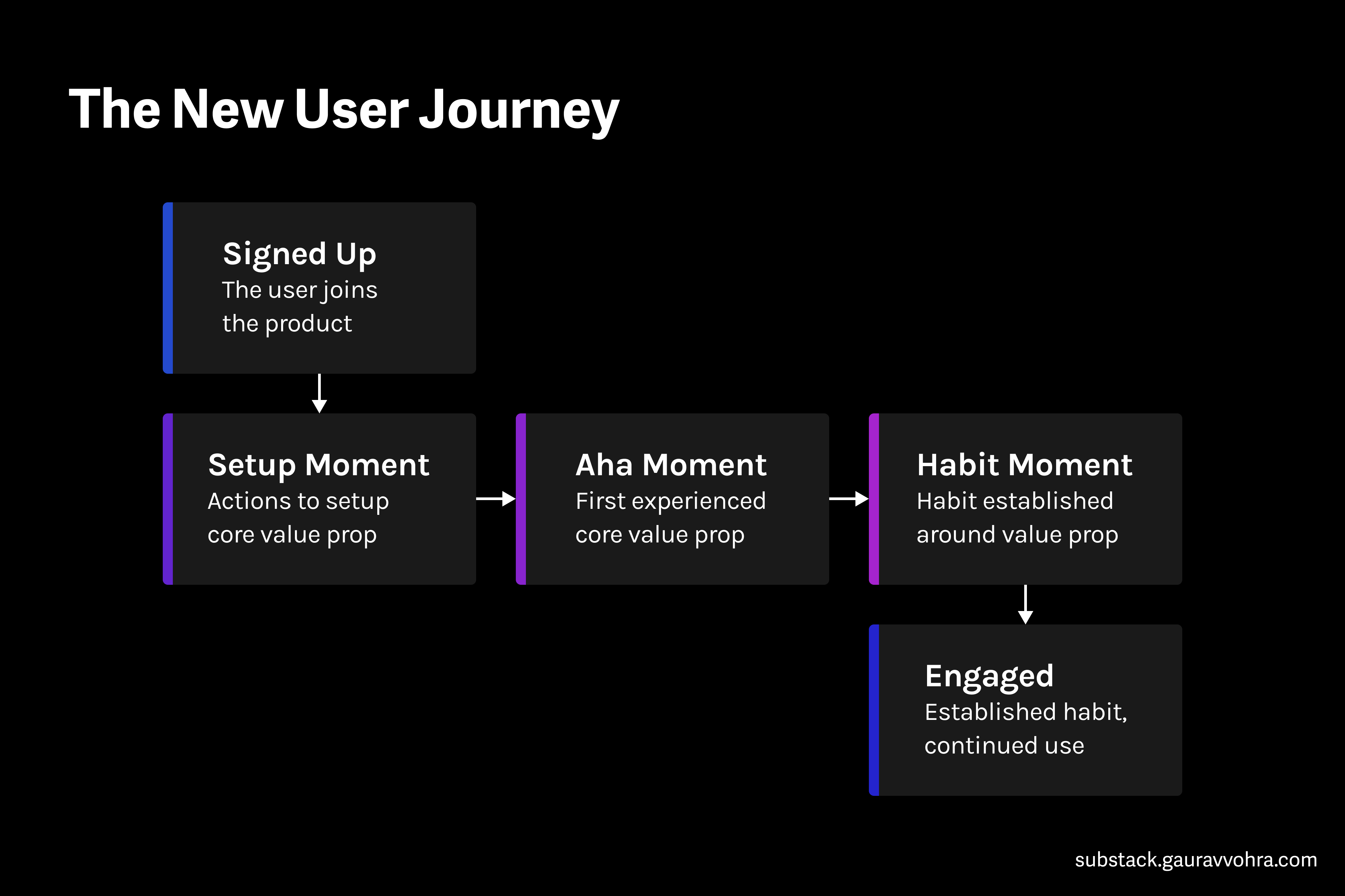
Casey Winters and Shaun Clowes define these precisely. I consider these mandatory reading if you are driving activation:
The “aha moment” is when a user first experiences your product’s core value proposition.
To define this moment in your data, look for a signal that the user has taken the core action that delivers your product’s value prop for the first time within some initial time period.
The goal is to know what moment tells us if the user is likely to develop a habit.
— Define your aha moment
And:
The “habit moment” is where the user has established a habit around the core value proposition.
A habit implies that they’ve taken the action a repeated number of times within a certain time period.
The amount of time it takes to build a habit varies depending on the product, the complexity of the habit, and the individual person.
— Define your habit moment
Examples:
Slack
Aha: 3+ messages exchanged in the first 7 days
Habit: 1+ message exchanged on 4+ of the first 7 days
Airbnb
Aha: 4+ star review in the first 6 months
Habit: 2+ bookings in the first 1 year
Think about what the “habit moment” is before you work on the “aha moment”.
Think about what an “engaged” user is before you work on the “habit moment”.
Then consider how the full user journey must change for more users to succeed.
7 is a lie
“7 friends in 10 days” is spuriously specific.
Of course, “8” friends is better than “7”, “9” days is better than “10”, and so on.
A better mental model, per Adriel Frederick on Lenny’s podcast:
As many friends, as fast as possible
“7” and “10” turn an idea — accumulating friends over time — into a binary outcome.
This lets you construct a KPI: the % of each new cohort hitting the “aha moment”.
KPIs are useful to track progress, establish causality, confirm incrementality.
But to actually improve the customer experience?
Product managers, designers, and engineers are better off helping users accumulate as many friends, as fast as possible.
Lines in the sand
How should your startup think about this?
The above guides explain how to pick a great “aha moment” and “habit moment”.
But no matter what, you are ultimately picking lines in the sand.
At Superhuman we wanted a product action to define our “aha moment”.
From first principles and regression analysis, we chose “emails cleared”.
We then wanted a frequency and time window.
We looked at the percent likelihood that a user was retained for different numbers of emails cleared over different time windows.
But ultimately we just picked lines in the sand.
“50 emails cleared within 7 days”.
And the stronger mental model was: “as many emails cleared, as fast as possible”.
Pick numbers, accept their imperfections, and move on.
A Frankenstein experience
Teams that follow the above thinking rapidly hit a sharp edge.
Despite all the structure — or perhaps because of it — it’s too easy for teams to ship a disjointed, Frankenstein experience.
This is especially common when different people are asked to own different parts of the journey.
A growth marketer owns the website. A growth PM owns the FTUE. A PMM owns activation emails.
Together, they build something fragmented and half-baked.
One brain, one journey
A single brain must own the full new user journey.
This brain should think like a hotel manager responsible for the entire guest flow.
From booking, to confirmation, to arrival, to check-in, to finding the room, to finding the spa, and finally, at long last, hitting the jacuzzi.
Let’s say you assign a Growth PM to work on activation.
Give them the full new user journey. This might be the first 30 days. It might even be the first 3 months.
Whatever it is, it should all be theirs.
As a first priority, they should create and maintain:
A simple paragraph describing the journey, including the “aha moment”, “habit moment”, and “engaged” state
A document articulating each step of the journey clustered into areas like “first minute”, “first hour”, “first day”
Tools like Adora make this remarkably easy. Especially when your onboarding grows in complexity across use-cases, languages, devices, and more.
Now, with this one brain owning the whole experience, how should they focus?
How much effort should go into the first minute, versus the first hour, day, week, or month?
Use a sliding 80:20 rule.
80% of focus on the first minute, 20% on the first hour.
Ignore anything beyond the first hour.
When the first minute is extremely dialed in, shuffle the 80:20 along.
80% of focus on the first hour, 20% on the first day.
Keep doing this until you have built something remarkable.
One-trick pony
Nearly everyone misses the following:
Facebook’s “aha moment” quietly one-shots three of its growth levers:
Value: Each new user experiences core value
Virality: Each new user creates more new users
Network: Every connection strengthens the network, raising value for all
Of course it was good to drive: it was a three-in-one.
It’s so obvious when you see it.
You could spend months on the “aha” and “habit moment”.
But even if you move the needle, gains will be modest at best.
What’s better?
As many levers, as quickly as possible
Simply:
Identify all your growth levers
Figure out how they relate to new users
Tastefully add them to the new user journey
For example, Superhuman asks new users to invite their team before they land in the product.
I remember the pushback:
“Why are we prioritizing this? How will it improve activation?”
The team’s honest reply:
“It won’t.”
And it didn’t.
But that one step drives 40% of all team invites. It’s probably more valuable than any other activation work the team did.
Think about your growth levers, and how you might fold them into the new user journey:
Revenue expansion → Get new users to buy the next tier
Word of mouth referrals → Get new users to add friends
Team expansion within a logo → Get new users to add their team
User-generated content → Get users to create and share on social
Collaboration network effects → Get users to collaborate
The key, of course, is to insert them tastefully.
If you keep it tasteful, you can ask for a lot.
Much more than most realize.