

Superhuman in 2016. We had problems.
We were grinding hard.
But we barely had an MVP.
Our prototype was riddled with bugs.
We needed more engineers. We had 3 plus our CTO, but it was nowhere near enough.
We needed to triple to ship a basic MVP.
Being responsible for growth, I faced an impasse:
To grow, we needed a product
To have a product, we needed engineers
To have engineers, we needed to speed up hiring
The bottleneck was clear. Hiring was our growth constraint.
So I did the responsible thing and jumped into hiring.
I spent nine months hiring founding engineers to reach our target team size.
In this write-up I share:
What I wish I knew at the start
Mental models that saved us hundreds of hours
The spreadsheet that fully deconstructs the problem
This is for anyone scaling their team, particularly engineers1.
It works any time you’re urgently filling multiple roles, from your founding team to a late-stage pod.
Please share if you find it useful.
Hiring is basically growth
They both involve:
Defining your positioning and message
Reaching a large top of funnel
Optimizing every conversion step
If you’re good at growth you should be good at hiring2.
You just need to understand the system and do the work.
Define your positioning and message
Your startup won’t grow if you can’t explain why customers should care.
Similarly, your startup won’t hire if you can’t explain why candidates should care.
Answer the following questions.
What is your company? What is its mission and vision3? Why should someone care?
What is your product? What problem does it solve? Why is it special?
What’s exciting about your company? Why will it win? Who are notable teammates, investors, customers?
What’s the cash and equity? Benefits? Culture?
These should collectively answer: Why should I join your company?
Particularly an engineer who can sleepwalk into a $600k+/year job at FAANGAMANGO4, or start their own company and own most of it.
Write down your answers, as you’ll use them throughout the hiring process:
Messaging candidates before interviews
Pitching candidates in early interviews
Closing finalists
Next, refine your words and practice saying them out loud.
Why?
Impressions matter.
Candidates will forget 90% of what you tell them, but they’ll remember how they felt.
In early interviews, you only have a few minutes to pique or lose candidate interest.
In late interviews, you need to stand out amongst the crowd.
You want candidates to feel excited and impressed. They should think “I love that company!”
Knowing what to say makes every second count.
At Superhuman, everyone running interviews authored their own one-page pitch doc, and it worked5.
Reach a large top of funnel
You’ve defined your message. You now need to go to market.
The first step is understanding your channels.
Hires generally come from these four places:
Inbound
Hiring platforms
Referral
Cold outreach
Inbound
This channel is obvious: candidates who apply for the job.
These candidates are often prudishly dismissed as low quality.
People who say this are wrong. Possibly low quality themselves.
Inbound applicants have reliably been some of my best hires across every role, including founding engineers.
Get your job on as many boards as possible (LinkedIn, Glassdoor, Indeed, Teal, etc). Then market the hell out of it.
Hiring platforms
These are active candidates, findable on platforms, waiting to be messaged.
Tthey don’t know about your company so you must pitch them.
Like inbound, this channel is often dismissed as low quality.
But again, this is wrong. Again, many of my best founding engineers were sourced on hiring platforms.
Hiring platforms come and go, but some at the time of writing: Paraform, Wellfound and Next Play. Campus recruiting is also a form of hiring platform.
Referral
Referral is what usually comes to mind when trying to scale a team.
Who’s in your network? Your network’s network?
Think broad. You, team, friends, family, investors, advisors, early customers. Run a memory palace with them all.
Use the latest tools like LiftOff and Happenstance.
Go beyond network: pay attention to industry events.
If a startup just got acquired or shut down, see who in your network will connect you to the talent list.
If an event is bringing candidates into one space, score an invite through your network and show up.
As we’ll see, this channel is usually the most important, so invest heavily in it.
Cold Outreach
These passive candidates are happily minding their own business. Few are job hunting.
You hope to pry them from their current occupation to focus on your startup.
This channel is the most scalable but the hardest to convert.
It can feel depressing. Hundreds of outreaches, only to get one or two “no thanks” replies.
Fortunately a litany of tools exist to help. LinkedIn Recruiter, Gem, Juicebox, Clay, Clado, Brix, and more.
You can either ramp up on these and DIY, or outsource to a recruiter.
I always recommend the latter.
Find a quality recruiter up to speed on the latest tools and techniques and judge on candidate volume and quality.
Note: While tooling isn’t the focus of this write-up, using the right tool can make or break your search.
But SaaS for recruiting is incredibly turbulent. Based on the last 10 years, half of these solutions probably won’t exist in another 10 years. YMMV.
Don’t see your favorite recruiting tech tool listed above? Message me to get it added. Did one above miss the mark? Let me know.
We’ve defined message and channels.
Finally, we must understand and optimize the funnel.
Optimize every conversion step
There are 5 stages to a typical hiring funnel6.
Outreach → Screen → Onsite → Offer → Accepted
Let’s now introduce the master spreadsheet.
This is your source of truth model; a reliable way to hit your hiring goals.
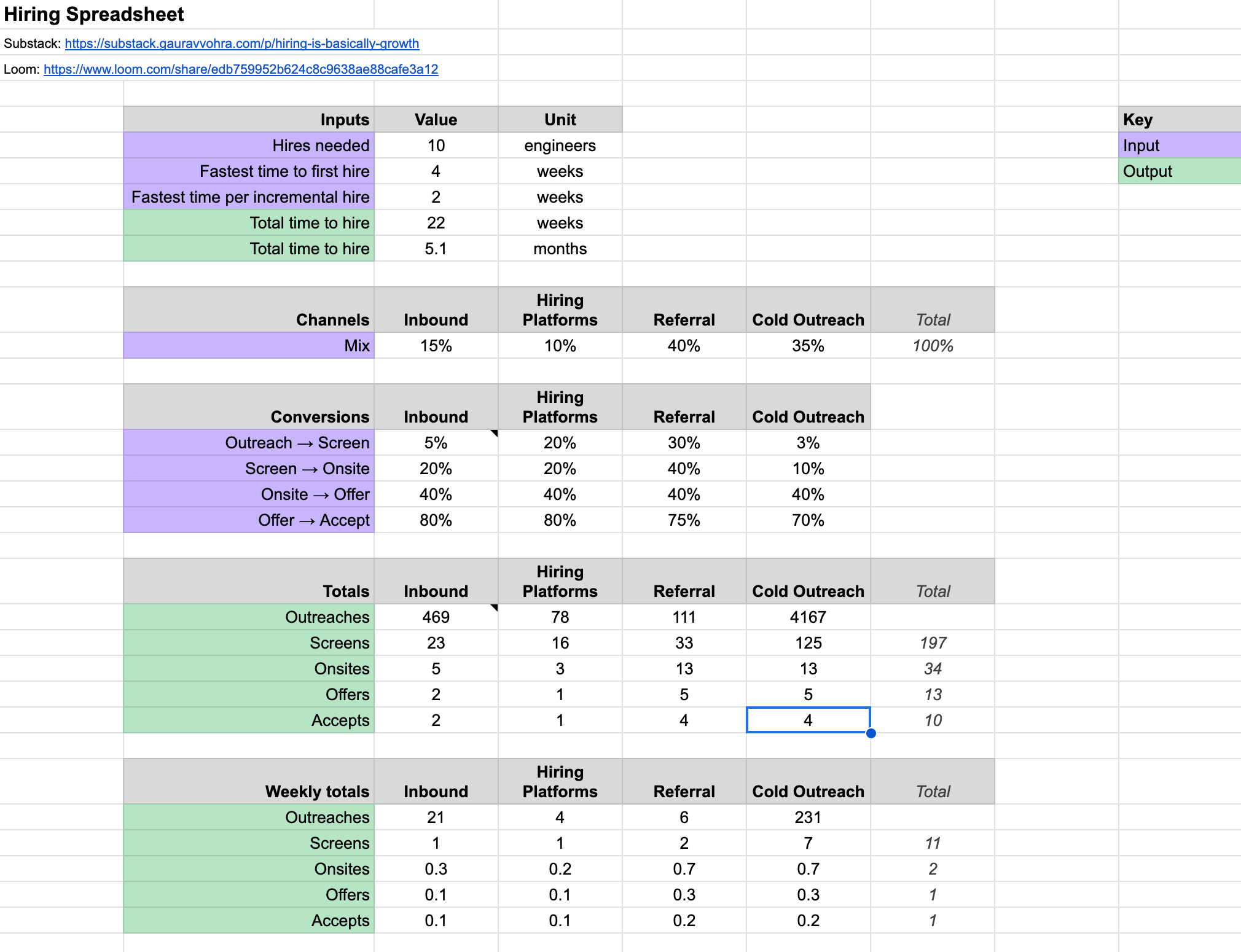
Click here to copy the spreadsheet.
Next, watch this Loom for an explanation.
Prefer to read? Keep going 👇
Hires needed
Everything starts with the number of hires needed.
In this example we’re going big: we need 10 hires.

Punch in your target at the top.
Time to hire
Assert your fastest possible time to hire.
I say “fastest” on the assumption that your startup will die without these hires, so you’re giving it everything.
If that’s not the case you should focus on something other than hiring.
For engineers my rule of thumb is 4 weeks for the first hire, and 2 weeks per incremental hire once the recruiting machine is running.
So:
1 hire should take 4 weeks
5 hires should take 4 + 2 + 2 + 2 + 2 = 12 weeks, or just under 3 months
10 hires should take 22 weeks or just over 5 months
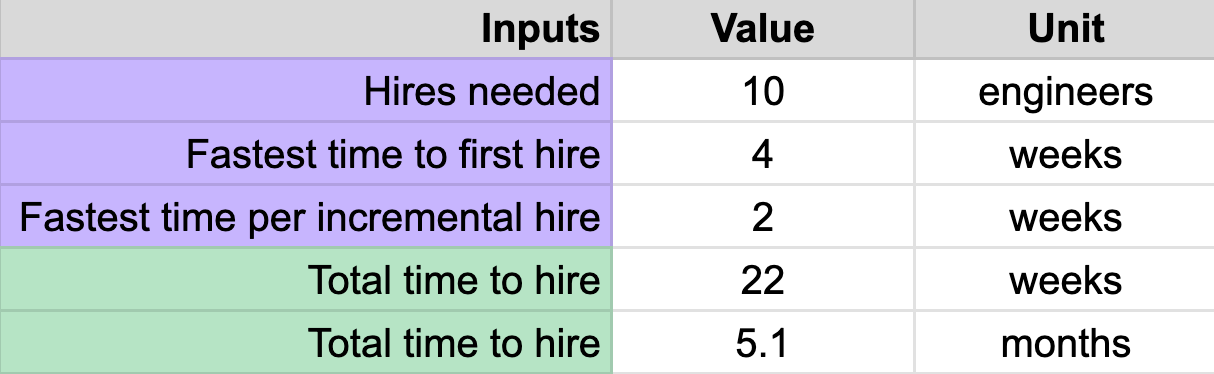
Put your numbers in. Sense check the conclusion.
Channel Mix
We next must assert a channel mix.
For a batch of hires, what % should come from inbound vs. hiring platforms vs. referral vs. cold outreach?
For founding engineers I typically see:
Inbound: 15%
Hiring platforms: 10%
Referral: 40%
Cold outreach: 35%

Don’t like this mix? Change it. Just make sure it adds to 100%.
Conversion Rates
Finally we must assert conversion rates.
Per channel, what % will move from each interview stage to the next?
You might assume pushing to 100% is ideal.
But hiring obviously doesn’t work that way:
Candidates won’t meet the bar
You want to minimize time spent on candidates you won’t hire
But hiring necessarily involves interviewing candidates who ultimately do not pass, even with strict top-of-funnel filtering
Good candidates will drop out
You want to minimize regrettable drop-out
But you won’t convert everyone, even with perfect selling
These are the percentages I see in healthy founding engineer hiring funnels:

In the Loom I elaborate on why these numbers.
A key principle is that the percentages should increase as candidates get deeper in the funnel.
This means you are narrowing in on the best candidates in every step.
In reality, how good or bad you are at marketing, targeting, screening, and selling will dramatically affect these percentages.
The above are very good conversion rates. Consider them healthy targets to aim for, even if your starting point is completely different.
The model will now spit out detailed, concrete recruiting goals.
Total Outreaches
The top row tells you the numbers you must hit to close 10 hires:

In this example, you need to:
Receive ~500 applications7
Message ~100 candidates on hiring platforms
Contact ~100 referrals in your network
Cold outreach ~4000 profiles
If you do this and the conversion rates hold, you’ll hit your hiring goals.
Total Interviews
The rest of the first table tells you how much total activity is needed.
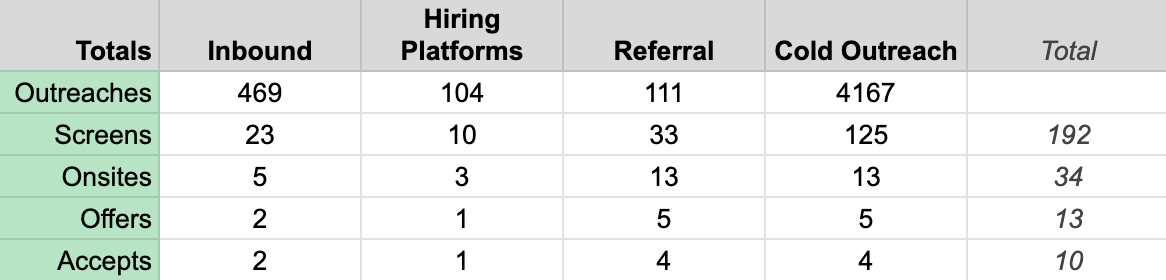
In this example you must run 192 screens and 34 onsites to reach 10 hires.
Remember these numbers when you design the interview plan.
If you make the onsite 4 hours, you’ll spend 136 hours or 17 days interviewing. If you make it 8 hours you’ll spend 34 days in onsites.
That’s a sickening 7 full weeks just doing onsites!
The takeaway is clear: design the most efficient interview imaginable.
Beyond onsites, you’ll need to deliver (at least) 13 offers to get to 10 accepts. Bitter pill to swallow, but best to recognize up front.
Weekly Interviews
The final section tells you how much weekly activity you need.
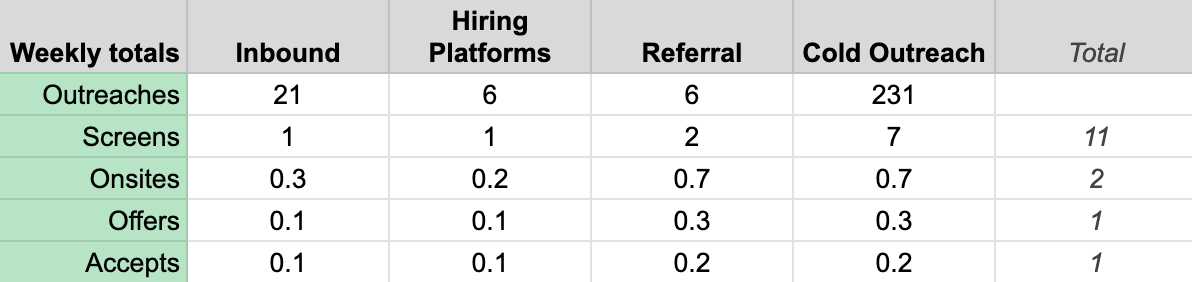
In this example, you must do (at least) 11 screens, 2 onsites, and give 1 offer each week to hit the goal.
Of course, it’ll be difficult to hit these numbers from a standing start. You’ll likely miss in the first few weeks.
The model takes this into account, creating enough buffer so that if you’re hitting these numbers by week 5, you’ll make the hires.
Where next?
The stage is set.
Admittedly we haven’t touched the messy part of recruiting: branding, making noise on social, rifling through your network, getting jobs live, outreach, hiring recruiters, running events, showing up for coffee chats, interviews, exercises, work trials, sell dinners, offer letters, negotiation, start dates, onboarding…
But at least you have a plan.
Back to 2016. Back to Superhuman.
This was the exact process we followed.
And it ran like a well-oiled machine.
Each week we tracked volume. We debugged conversions. We made the hires.
Now it’s your turn:
Do the work and build your team.
Why am I focused on engineers? Because, generally, you only need 1 of other key roles, so you can generally hire them out of your network. But startups typically need to need to hire ~3-10 engineers at a time, especially at the start. This scale demands a fundamentally different approach to hiring.
Oddly, the opposite is definitely not true.
These two words are frequently bandied about, so let’s clarify them. A mission statement describes the current central purpose and goal of an organization, to guide daily decision making and performance. A vision statement describes what an organization seeks to become, or the ideal society to which the organization seeks to contribute. More here.
Or whatever it’s called these days.
Each stage consists of multiple interviews, often spread over multiple days. But for modeling purposes we simplify and bucket into 5 stages.
Inbound might be much leakier for certain roles and companies. A desirable role at a very buzzy startup might only have a 1% conversion to screen rate, not 5%. Obviously this 5x’s the number of applicants needed.
This is great because it forces you to actually look at the numbers most people ignore: how many touchpoints, how many screens, how many offers you really need to land 10 strong hires.
//The only thing I’d add # review these numbers every week, make one person clearly responsible, and don’t blame “talent shortage” until you’ve genuinely hit this level of outreach.//
Damn, the numbers don’t lie. An honest and humbling account of what The Work looks like. Thanks for making your hindsights my insight. 🫡